

15 Systems Every ABA Center Needs: Modern Childcare Management Solutions
Growing an autism center is an incredibly rewarding journey because it means you can help more families in your community. As a director, you have likely built a wonderful team of therapists and created a space where children truly succeed. Naturally, this clinical success brings on a growing desire to expand your reach and support families waiting for your care. However, successful growth requires more than hiring extra staff, signing new leases, and more. You need a solid operational foundation to ensure your quality of care remains high while your business expands. Every location or added therapy room requires systems that connect clinical data with scheduling and financial tracking. In this guide we will discuss the specific tools and strategies you need to safely scale ABA practice operations. So, keep reading as we walk you through exactly what your clinic needs to manage growth, organized into clear categories like demand tracking, financial discipline, and team supervision. Let’s get startedKey Takeaways
- Spread out your referral sources: Relying on just one or two doctors is risky. Build connections with at least 15 local partners so your intake pipeline stays steady and predictable.
- Keep your team’s time balanced: Aim to have your therapists spend around 75 percent of their week working directly with kids rather than getting bogged down in office tasks.
- Put all your tools under one roof: Working with three or four different apps leads to missing notes and billing errors. Bring scheduling, therapy notes, and claims into a single connected system.
- Let software handle the busy work: Use automated trackers for insurance approvals and staff clock-ins so your clinic never delivers unpaid therapy hours by accident.
- Protect your leaders from burnout: Build clear support layers between owners, directors, and technicians so everyone receives the mentorship they need to stay happy in their roles.
Demand & Growth Systems
Before you add a new therapist to your payroll, you need a predictable line of families waiting for your care. If you hire staff without having clients ready to start right away, you will end up paying full-time salaries for empty therapy rooms. Now, that is the reason why learning how to safely scale ABA practice operations starts with organizing how families discover and enter your clinic. Think of your client intake process like a relay race where every step passes the baton cleanly to the next person. The flowchart below illustrates how a healthy intake pipeline turns community trust into steady therapy sessions without any guessing games: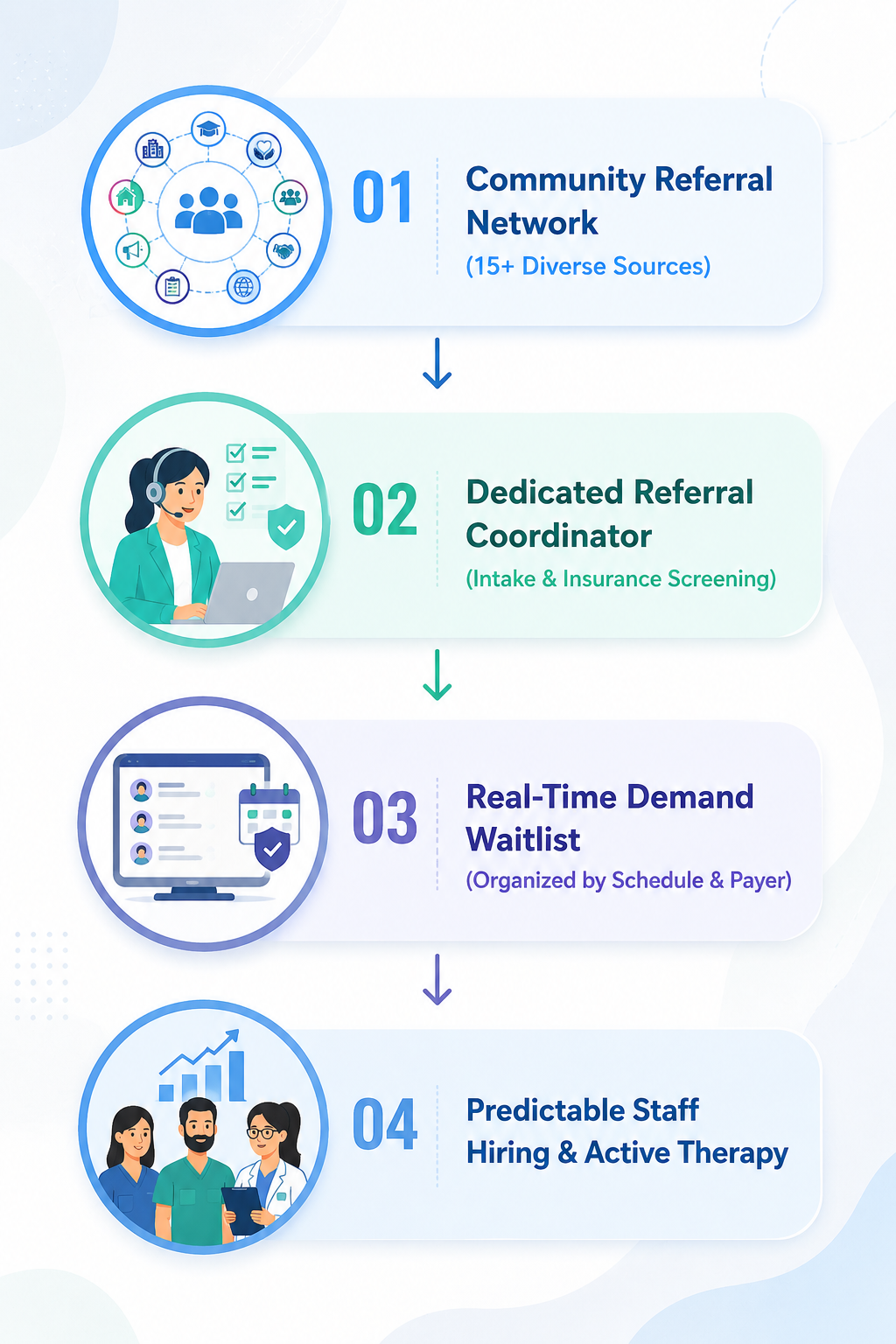
1. A Diversified Referral Network
A diversified referral network means receiving consistent client recommendations from at least 15 separate community partners rather than relying on just two or three sources. Imagine relying on only two local pediatricians for all of your new clients. If one of those doctors moves away, half of your incoming business disappears overnight. Spreading your network across many partners creates a safety net so your clinic always has families reaching out for help.- Apply the 15-source rule: It is much safer to have 15 doctors who each send you two clients a month than two doctors who send you 15 clients each.
- Enforce the 30 percent rule: Ensure no single hospital or clinic provides more than 30 percent of your total client inquiries.
- Connect with local specialists: Build friendly relationships with speech therapists, occupational therapists, pediatricians, and local school coordinators.
Referral Concentration Risk
| Number of Referral Sources | Average Monthly Referrals per Source | Total Monthly Inquiries | Financial Impact if One Source Stops |
|---|---|---|---|
| 3 Sources | 10 Inquiries | 30 Families | Lose 33% of incoming client pipeline |
| 5 Sources | 6 Inquiries | 30 Families | Lose 20% of incoming client pipeline |
| 15 Sources | 2 Inquiries | 30 Families | Lose only 6% of incoming client pipeline |
2. Dedicated Referral Coordinator
A referral coordinator is a dedicated team member who answers incoming calls, verifies insurance, and guides families through the initial intake process. When parents seek help, they are often stressed and need quick answers. If the clinical director tries to answer those calls while also managing therapy sessions, voicemails will get missed and parents call another clinic. A dedicated coordinator ensures every parent gets a warm, helpful response right away.- Start with fractional hours: You can hire someone for just 10 to 15 hours each week to handle phone calls before turning it into a full-time job.
- Maintain fast response times: Your coordinator should call back every family within 24 hours of their first message.
- Keep paperwork moving: They collect diagnostic reports, check insurance benefits, and pass completed files to your clinical team.
3. Real-time Waitlist & Demand Visibility
A real-time waitlist is an organized tracking system that shows exactly which approved families are ready to start therapy the moment a therapist has an open slot. Feeling busy at the clinic does not mean you are ready to hire. You need clear data showing how many families are completely screened, approved by insurance, and waiting for an open appointment. According to health tracking from the CDC Autism Data reports, community demand for services is increasing, but you must match or align with that demand to your exact schedule needs.- Track schedule preferences: Record whether a waiting family needs morning, afternoon, or weekend hours so you do not hire a therapist for the wrong shift.
- Filter by insurance plan: Group waiting families by their insurance company so you can match them with clinicians who are already approved in those networks.
- Set clear hiring triggers: Only post a job opening for a behavior technician when your waitlist has enough verified clients to fill a full schedule immediately.
Financial Discipline
Bringing in new families is exciting, but expanding your center without a solid budget plan can quickly get your business into trouble. Think of your finances like an airplane control panel, where four clear gauges show whether you have enough fuel and speed to fly safely. The four-part pipeline below outlines the exact financial checks you must monitor before spending money on new hires or bigger therapy spaces.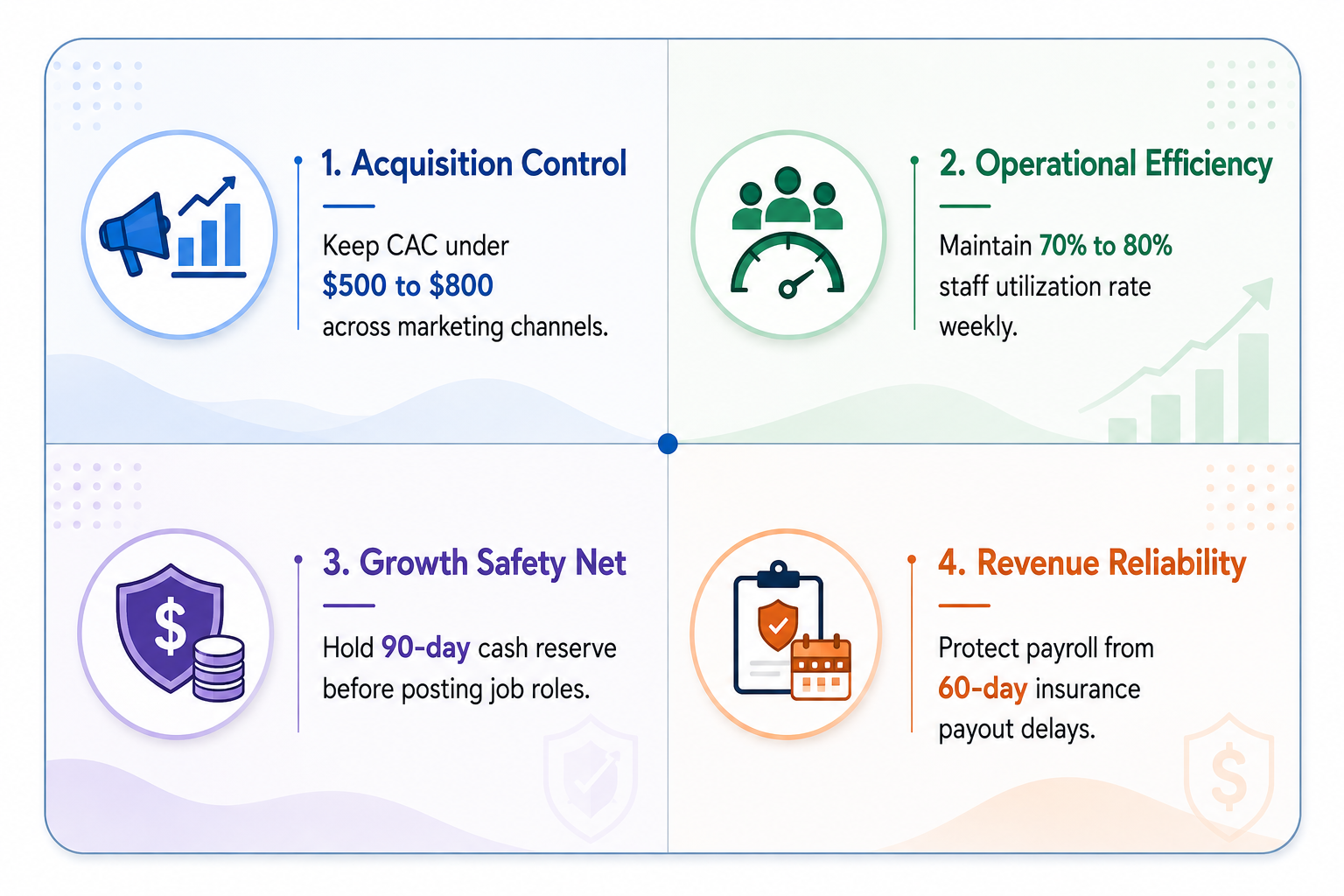
4. The Client Acquisition Cost (CAC) Tracking
Client Acquisition Cost tracking measures the total sales and marketing dollars spent to enroll a single new client in your therapy program. Understanding acquisition costs helps you make smarter choices about your outreach budget. You calculate this number by dividing your total monthly marketing spend by the number of children who officially start therapy. When you know this figure, you can invest more money in the channels that work and stop paying for advertisements that bring in zero families.- Set a spending boundary: Aim to keep your acquisition cost between $500 and $800 per enrolled child to protect your profit margins.
- Evaluate outreach channels: Track which doctor visits or online ads bring in committed families, and stop spending money on channels that cost more than $1,000 per lead.
- Factor in client retention: A higher initial enrollment cost is reasonable only if families stay enrolled in your center for several years.
5. Clinician Utilization Rate Dashboards
A clinician utilization rate dashboard calculates the percentage of a therapist’s available working hours spent delivering billable direct care. Directors often assume their therapists spend 80 percent of their week working directly with children. In reality, unexpected cancellations and paperwork often pull that number down to 60 percent. This gap between expectation and reality eats away at your revenue because you pay full-time wages while billing insurance for only part of that time. A live dashboard displays these numbers clearly so you can fix scheduling gaps immediately.- Establish target ranges: Aim for an overall team utilization rate between 70 percent and 80 percent across all clinical staff.
- Fill cancelled slots quickly: Track daily cancellations in real time so your administrative team can offer open hours to families on your waitlist.
- Automate session notes: Give therapists modern tools to complete their daily documentation quickly so they spend less time typing and more time with kids.
Financial Benchmarks for Scaling Clinics
| Operational Metric | At-Risk Level | Healthy Target Level | Operational Benefit |
|---|---|---|---|
| Client Acquisition Cost | Above $1,000 | $500 to $800 | Protects outreach budgets from excessive spend. |
| Clinician Utilization Rate | Below 60% | 70% to 80% | Ensures clinical staff time covers payroll expenses. |
| Cash Reserve per Hire | Less than 30 Days | 90 Days | Prevents payroll strain during insurance claims delays. |
6. A 90-Day Growth Cash Reserve Before You Hire
A 90-day growth cash reserve is a dedicated savings fund that covers three consecutive months of an employee’s wages before you post a job opening. When a new Board Certified Behavior Analyst (BCBA) joins your team, building their full client schedule takes time. In addition, insurance companies often take 60 to 90 days to approve credentialing and pay out initial claims. If you do not have savings set aside, you will have to pay large salaries out of pocket while waiting for the insurance checks to clear.- Calculate the true cost: Add up base salary, payroll taxes, health benefits, and tablet equipment before you start interviewing.
- Save upfront: Keep approximately $25,000 in a growth savings account for every full-time clinician you plan to hire.
- Protect payroll security: Having this cash cushion means you will no longer have to worry about making payroll on Friday while waiting on insurance payments.
The Technology & Compliance
As your center welcomes more children and therapists, managing client files on paper forms and disconnected spreadsheets becomes impossible. Think of your clinic’s technology like the central hub of a smart house, where one main control panel connects your schedules, in-home visit tracking, and insurance rules together. The image below shows how a single practice management hub directs daily therapy sessions directly into clean, compliant billing claims.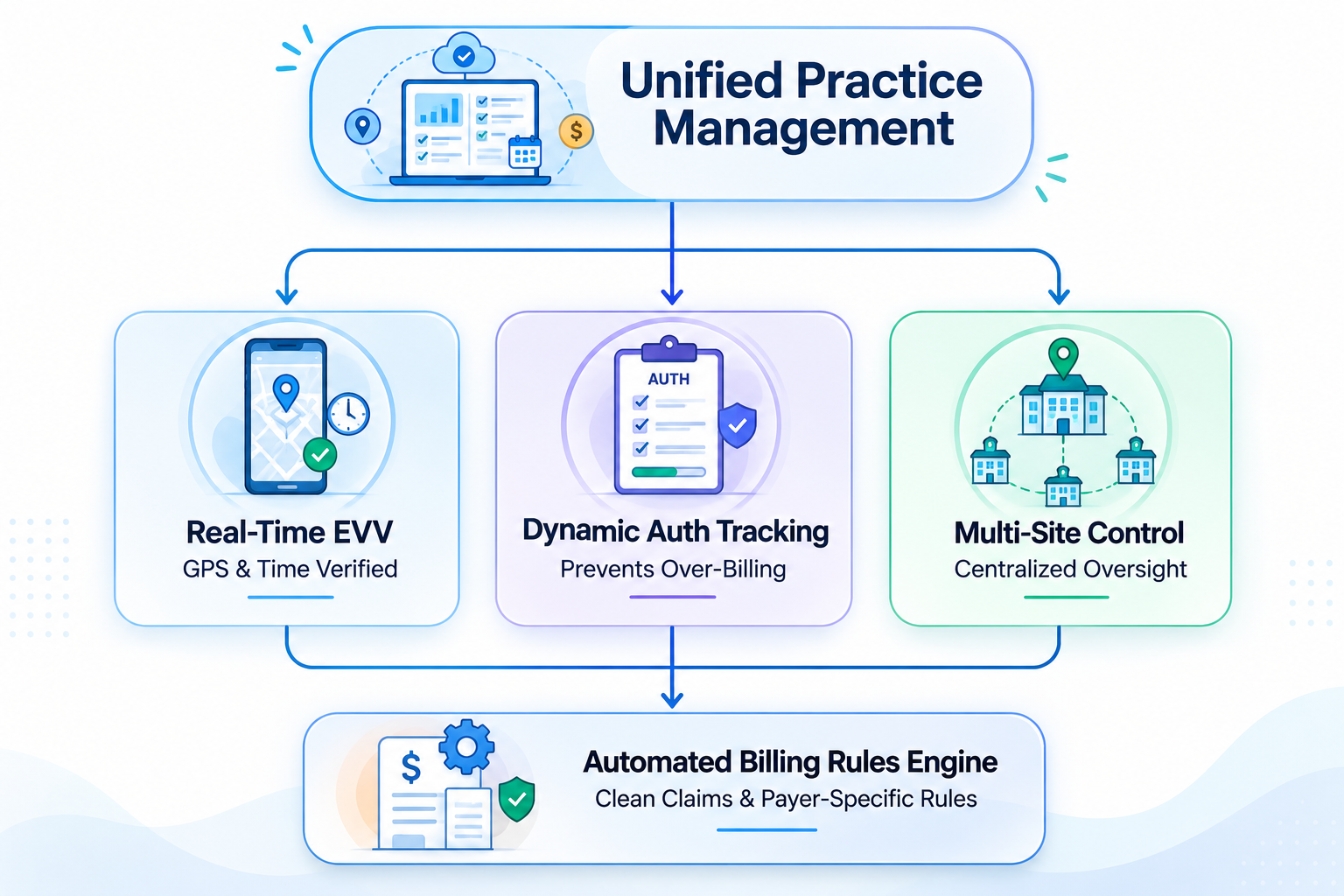
7. One Unified Practice Management System
A unified practice management system centralizes scheduling, clinical documentation, and billing into a single shared database. Managing an autism center with several separate computer programs creates unnecessary friction for your team. When appointments live on one calendar, session notes sit in a separate app, and billing happens somewhere else, important client details easily get lost along the way. Bringing everything together inside modern ABA practice management software keeps your entire team at the same level. As your center expands into locations, this single source of truth becomes even more valuable. Using connected multi-site ABA software ensures that clinical notes, direct therapy hours, and insurance claims flow together without anyone having to retype information. This organized setup also keeps your files completely prepped for licensing audits without any extra stress.- Enter information once: Type a family’s details into the system once, and let that data fill daily schedules, therapy goals, and claim forms automatically.
- Convert notes into claims instantly: When a therapist finishes and signs their session note, the software immediately prepares the billing claim for your review.
- Reduce software fatigue: Give your team one simple login where they can check their calendar, submit clinical notes, and message supervisors easily.
8. Real-Time Authorization & Utilization Tracking
Real-time authorization tracking automatically deducts completed session hours from insurance-approved totals to prevent unbillable service overages. There is nothing more frustrating than delivering weeks of therapy only to discover that the client’s authorized insurance hours ran out a month ago. Insurance companies will not pay for unapproved care, leaving your clinic to absorb the financial loss.Pro Tip: Implementing automated ABA authorization tracking keeps your schedule completely safe.
- Watch visual balance meters: Schedulers should see clear visual meters directly on the calendar interface showing exactly how many approved hours remain for each child.
- Receive automatic warning alerts: Set the system to notify case managers the moment a child reaches 85 percent of their approved hours so they can submit reauthorization packets early.
- Lock down expired schedules: Modern platforms should automatically prevent an appointment from being booked if the child’s insurance approval has expired.
9. Credential-to-Schedule Matching
Credential-to-schedule matching blocks receptionists from booking appointments with staff members who lack active approval from the client’s payer. Every insurance company enforces different rules regarding who can provide therapy to their members. If you accidentally schedule a technician who has not yet received formal credentialing from a specific insurer, that insurer will deny every single claim for those sessions.- Stay ahead of document renewals: The system should automatically alert leadership 60 days before a staff member’s CPR card, background check, or state license expires.
- Enforce payer-specific restrictions: Prevent schedulers from booking appointments unless the selected therapist meets the exact educational criteria set by that family’s insurance policy.
- Eliminate audit fears: Rest easy knowing that every single session on your calendar is matched with a clinician who is fully recognized and approved by the payer.
10. Electronic Visit Verification (EVV) Compliance
Electronic Visit Verification uses GPS location tags and digital timestamps to verify that therapy sessions occur at approved locations. If your center provides in-home or community therapy sessions through Medicaid programs, strict location proof is a legal requirement. Maintaining complete ABA EVV compliance protects your agency from state penalties and ensures accurate billing records.- Simplify mobile clock-ins: Provide your technicians with a straightforward mobile app that lets them check in and out with a single tap when arriving at a family’s home.
- Use geofenced security: Record precise GPS coordinates that verify the therapist is physically present at the client’s address during the scheduled appointment window.
- Capture digital signatures: Allow caregivers to sign on the mobile screen at the end of each session to confirm the hours delivered and review the goals targeted.
11. Multi-Site Governance & Centralized Reporting
Multi-site governance provides executive leadership with a single dashboard to monitor operations, revenue, and clinical notes across multiple facilities. Opening your second location is a proud milestone, but you cannot be in two places at once. If you try to manage multiple buildings through phone calls and physical visits, small operational problems will slip past your attention. Adopting specialized multi-site ABA software allows you to oversee every clinic room from your main office.- Compare location performance: Review cancellation trends, billing efficiency, and clinical progress across all your buildings side-by-side on one screen.
- Standardize center policies: Make sure that employee conduct rules, session note formats, and parent communication guidelines stay identical across every branch.
- Centralize your administrative team: Allow a single billing and intake team to support multiple physical facilities without duplicating administrative salaries.
12. Accreditation-Ready Documentation
Accreditation-ready documentation organizes client files, supervision logs, and treatment plans to satisfy standards set by governing bodies like BHCOE or CARF. Earning BHCOE accreditation is a wonderful way to prove your clinic’s dedication to high-quality behavioral healthcare. However, going through an accreditation review is stressful if your client binders are missing signatures or your supervision hours are recorded on paper scraps.- Maintain automated audit trails: The software should record a digital log showing who created a note, when a supervisor reviewed it, and who signed off on it.
- Prevent incomplete entries: Clinicians should be unable to submit daily session notes until every single mandatory observation box is filled in completely.
- Keep everything in a secure location: Store diagnostic assessments, consent forms, and physician referrals in organized digital folders that your team can access in seconds.
13. A Schema-Based Automated Billing Infrastructure
A schema-based billing infrastructure adapts dynamically to changing payer rules and state requirements without requiring manual code changes. Insurance companies love to adjust their billing rules, add regional modifiers, and change how they process claims. If your billing software relies on rigid, outdated logic, every small payer change will bring your cash flow to a standstill. Choosing modern ABA billing automation gives your practice the flexibility to adapt to changing insurance demands instantly.- Adapt to insurance changes instantly: Adjust your claim rules across individual private and Medicaid plans without waiting months for a programmer to rewrite the software code.
- Catch errors before submission: The system should automatically scan every single claim for missing diagnostic codes, incorrect modifiers, or invalid dates before sending it out.
- Eliminating payment delays: Submitting clean, accurate claims the first time around cuts your payment wait times from months down to a matter of weeks.
Legacy Billing Workflows vs. Modern Schema-Based Billing
| System Capability | Outdated Rigid Software | Modern Schema-Based Infrastructure |
|---|---|---|
| Adapting to Payer Rule Changes | Requires expensive custom coding by the software vendor | Lets clinic administrators update billing parameters in minutes |
| Pre-Claim Validation | Flags billing errors only after the claim is rejected by payers | Scans claims automatically for missing provider data before filing |
| Insurance Policy Flexibility | Applies the same broad rules to every payer | Customizes claim formatting for every specific private and state plan |
People & Supervision
Your behavior technicians and BCBAs help make your center special every day. In addition to putting your clinical values into practice, they celebrate milestones with your learners, comfort worried parents in times of difficulty, and share your clinical values with the world. So, when your clinicians feel supported, respected, and properly trained, your entire center flourishes and your families receive steady, dependable care. To protect your team from exhaustion as you welcome more families, you need an organized hierarchy that distributes the responsibilities fairly, just like the leadership structure shown below.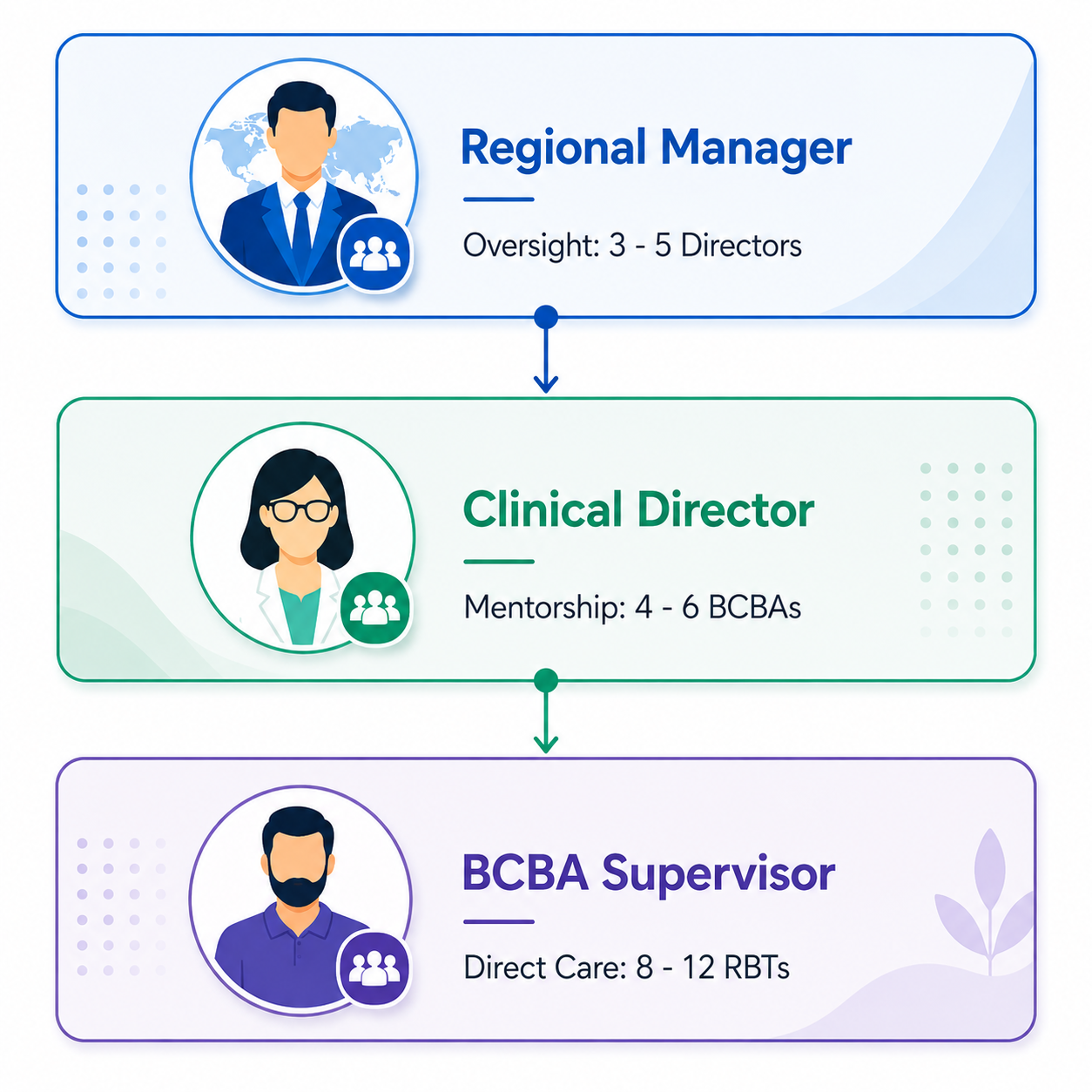
14. Standardized Onboarding & Competency-Based Training
Standardized onboarding uses skill-based evaluations and structured mentorship to prepare newly hired technicians for direct care quickly and safely. Starting out as a behavior technician can feel overwhelming. Handing a beginner a tablet and sending them straight into a session with a child with high-intensity behaviors leads quickly to early burnout. The latest workforce numbers from BACB Certificant Data reveal that while many people enter the behavioral health field each year, retaining them requires compassionate guidance and thorough preparation.- Evaluate real-world competencies: Test candidate understanding through role-playing and hands-on demonstrations rather than merely written multiple-choice tests.
- Pair beginners with trusted mentors: Always, have every technician shadow an experienced peer for their first month so they always have someone to turn to for advice and encouragement.
- Build clinical confidence early: Structured, supportive onboarding programs can lower first-year staff turnover by nearly 25 percent while helping technicians feel comfortable on the floor 40 percent faster.
15. A Tiered Supervision Structure
A tiered supervision structure organizes clinical staff into clear management levels so supervisors maintain direct report ratios of between 8 and 12 staff members. When a single clinical director oversees 20 different behavior technicians, nobody gets the attention they deserve. The director becomes completely overwhelmed with administrative questions, while the technicians feel isolated on the floor. Creating a three-tier supervisory structure ensures that every employee has a dedicated mentor looking out for their day-to-day clinical growth.- Level 1 BCBA Supervisors: Guide 8 to 12 behavior technicians directly, including writing programs, observing sessions, and supporting families.
- Level 2 Clinical Directors: Mentor 4 to 6 BCBA supervisors, handling complex clinical escalations, quality assurance, and staff development.
- Level 3 Regional Managers: Direct multiple clinic facilities, focusing on broad community outreach, operational health, and organizational expansion.
Tiered Supervision Roles and Ratios
| Leadership Level | Primary Clinical Responsibility | Recommended Direct Report Ratio |
|---|---|---|
| BCBA Supervisor | Program writing, hands-on coaching, direct observation | 8 to 12 Behavior Technicians |
| Clinical Director | Quality assurance, supervisor mentorship, family escalation | 4 to 6 BCBA Supervisors |
| Regional Manager | Operational health, multi-facility culture, program growth | 3 to 5 Clinical Directors |
Why This Matters More Than Ever: The ABA Interoperability Crisis
Right now, an estimated 4,000 ABA clinics across the country are operating on disconnected software setups. Their daily schedules live on one calendar, their clinical notes sit inside a separate mobile app, and their financial records are kept in an isolated billing system. Therefore, when your digital tools cannot communicate with one another, administrative breakdowns happen constantly.- Session-to-Claim Conversion: Therapists spend hours copying clinical notes into separate billing software, creating accidental typos that delay payments.
- Authorization Tracking: Daily schedules do not update alongside insurance approval balances, leading to hours of unbillable therapy.
- Credential-to-Schedule Matching: Receptionists inadvertently book children with therapists who are not yet approved by that family’s insurance company.
- EVV Compliance: Time and GPS records captured in the field fail to sync with state reporting portals, resulting in compliance warnings.
- Cross-Domain Reporting: Directors cannot view clinical outcomes and business profitability together on a single screen to make informed choices.
How iCare Software Helps ABA Facilities Scale
Building an operational foundation that supports your clinic’s expansion requires software that works as hard as your team does. iCare provides the unified management tools you need to expand your facility while keeping your daily administrative duties stress-free. Our platform brings your scheduling, clinical records, and billing tools together in one single database. You will never have to waste time exporting spreadsheets or typing client details into multiple apps again. Automated financial controls match insurance authorizations directly against scheduled sessions in real time, completely eliminating scheduling mistakes that lead to unpaid claims. iCare includes built-in session tracking and clinical documentation tied directly to BCBA supervision workflows. Integrated GPS check-ins keep your home-based appointments fully compliant with state Medicaid rules, while automated credential tracking alerts you before your employee license expires. With years of dedicated experience building administrative infrastructure for childcare and clinical programs, iCare gives your team the peace of mind that your operations are always organized and audit-ready.Frequently Asked Questions
How many referral sources should an ABA practice have to avoid dependency risk?
A healthy practice should build active relationships with at least 15 separate community referral partners who regularly send clients. Making sure that no single medical office accounts for more than 30 percent of your total client inquiries protects your clinic from sudden disruptions.What is a good clinician utilization rate for an ABA practice?
A strong utilization rate target falls between 70 percent and 80 percent across your clinical team. This balance ensures that your therapists spend the vast majority of their working day in direct, billable contact with children while still having enough time to write thorough notes and attend meetings.What is the difference between all-in-one and best-of-breed ABA software?
All-in-one software stores scheduling, clinical data, and billing records in one central database to prevent human error. Best-of-breed software connects several separate third-party applications together through custom integrations, which can occasionally experience data sync delays.What is EVV in ABA therapy and which states require it?
Electronic Visit Verification (EVV) uses mobile GPS tracking and time logging to verify that home-based therapy sessions take place at the correct address. Most state Medicaid programs mandate EVV compliance for home and community-based behavioral health services to ensure services are delivered as billed.How much cash reserve should a practice have before hiring a new BCBA?
Clinic owners should set aside three full months’ wages and benefits for every new clinician hired. Saving roughly $25,000 per position ensures your center can cover payroll comfortably while building that clinician’s caseload and waiting for insurance credentialing to clear.What accreditation should an ABA facility pursue, BHCOE or CARF?
Both BHCOE and CARF are widely respected accreditation organizations that evaluate clinical quality, safety, and operational excellence. Earning each credential demonstrates your center’s dedication to high standards and builds immediate trust with insurance payers and families.How does unified software help reduce administrative burnout for BCBAs?
Unified software eliminates duplicate data entry by automatically generating billing claims and progress reports directly from clinical notes. Removing this administrative burden gives your BCBAs more time to mentor technicians and focus on client progress.Is ABA practice management software required to be HIPAA compliant?
Yes, any software that handles protected health information must enforce strict privacy controls under federal law. You can learn more about securing your clinical files by reviewing our comprehensive guide to HIPAA compliance.Conclusion
Scaling an autism center is about much more than opening more rooms or hiring more staff. True expansion happens when you pair your clinical passion with steady referral habits, thoughtful financial discipline, and a unified software foundation. When these pieces work together, your team can expand your reach, support more families, and maintain the highest standard of care.
Whenever you are ready to simplify your administrative workflows and prepare your clinic for sustainable
growth, book a demo with us to see how our unified childcare management software can support your mission.