

Most childcare directors are into early childhood education because they love working with children and supporting families. They probably did not imagine spending Friday evening trying to figure out why the numbers in their bank account do not match the number of children enrolled.
Yet, that is exactly what happens!
Your classrooms are full and your families pay tuition on time. You collect your payments on time. But once payroll is covered, supplies are restocked, and every other expense is paid, the margins can look very small.
So where is the money flowing?
The problem is that the base tuition is only one piece of the picture. As soon as you add childcare subsidies, parent copays, sibling discounts, schedule changes, credits, or mid-month adjustments, billing becomes much more complicated. What looks like a simple monthly invoice is actually a chain of financial decisions, and even a small mistake at any point can quietly cost your center money.
That is where revenue leakage happens. Not always through one major, obvious error, but through small discrepancies that slip through the cracks month after month.
In this guide, we will break down why traditional childcare billing becomes difficult to handle, and how to audit the four key layers of your billing process. We will also talk about the practical steps you can take to catch revenue leakage before it becomes a recurring problem.
Key Takeaways
- Tuition is only line one: Base tuition makes up just 20 percent of billing complexity, while subsidies, copays, discounts, and schedule changes represent the volatile 80 percent.
- Treat subsidies as separate receivables: Government subsidies are expected payments, not cash on-hand. Tracking it in the same bucket as parent balances hides cash shortfalls.
- Copays require fixed rules: Treating copays as whatever is left over leads to missed adjustments whenever agency reimbursement rates change.
- Discounts must be conditional: Sibling and staff discounts need automated expiration rules so they do not silently persist after an older child leaves.
- Schedule shifts create domino effects: A mid-month schedule change alters subsidy eligibility, parent copays, and discount thresholds simultaneously.
- Routine audits protect margins: A structured weekly reconciliation of agency claims and a monthly accounts receivable aging review prevent thousands of dollars in lost revenue.
Why Is Base Tuition Only the Tip of Daycare Billing?
Most operational advice treats daycare billing as a basic three-step task: generate an invoice, collect the money, and follow up on late fees. That routine covers the predictable 20 percent of your balance sheet. The remaining 80 percent is variable, interdependent, and where earned money quietly disappears.
Consider a standard classroom scenario:
- A family qualifies for public assistance covering 60 percent of their base rate.
- Their second child receives a 10 percent sibling discount.
- Mid-month, the family dropped from five days a week to three.
In a spreadsheet or generic invoicing system, this single family profile requires manual recalculation across three separate records: the subsidy claim, the parent invoice, and the discount rule. If your staff updates the classroom attendance sheet but forgets to adjust the billing ledger, errors begin to accumulate immediately.
This is not a theoretical problem. Accounting professionals who audit early learning centers see this breakdown regularly. A published case study by Honest Buck Accounting documented a 60-child center where a routine six-month financial review uncovered $8,400 in uncollected revenue.
The losses came from three everyday administrative oversights:
- Three families were billed with outdated infant rates after moving to toddler classrooms.
- Two state subsidy reimbursements were never paid out because of missing attendance signatures.
- One automated recurring payment swallowed up for three consecutive months while the child continued attending.
None of those families tried to avoid paying. The center relied solely on tools that could not flag administrative exceptions. To protect operational margins, modern facilities rely on a shortened payment cycle that identifies ledger discrepancies before the billing period closes.
The Four Layers of Modern Daycare Billing Management
A standard invoice rarely tells the complete financial story. Also, a reliable childcare ledger breaks down into four operational layers stacked on top of base fees, each governed by its own timelines, verification rules, and common errors. Here’s how:
| Billing Layer | Operational Purpose | Primary Administrative Risk |
|---|---|---|
| Base Tuition Rate | Published tuition for the room or age group | Using outdated rates after annual fee increases |
| Layer 1: Subsidies | Government voucher or third-party agency funding | Blending agency receivables with private-pay balances |
| Layer 2: Family Copays | Out-of-pocket parent responsibility balance | Treating copays as manual leftovers instead of fixed lines |
| Layer 3: Discounts | Sibling, employee, and multi-program reductions | Forgetting to cancel discounts when eligibility expires |
| Layer 4: Schedule Shifts | Mid-month adjustments, drop-ins, and part-time shifts | Missing downstream changes to subsidies and copays |
Layer 1: Managing Childcare Subsidy Programs and Agency Ledgers
Accepting government assistance changes how your center handles revenue. You no longer manage one customer per seat. Instead, you manage two distinct payers: a government agency and a family.
These public assistance programs receive federal support through the Child Care and Development Fund (CCDF) and operate under regional welfare or human services departments. Because each state establishes its own rules for income verification, authorized hours, and reimbursement calendars, operational requirements differ widely across state borders.
The agency portion is an accounts receivable balance, which means it is expected revenue rather than cleared funds. Recording an anticipated voucher as earned cash before the agency deposits it produces distorted financial projections. If an agency withholds reimbursement because of an unverified attendance log, your operating budget suddenly faces a deficit.
Subsidy management usually breaks down in predictable ways:
- Paper attendance sheets lack the check-in timestamps or guardian signatures required by state monitors.
- Annual parent income recertification deadlines pass without center reminders, terminating coverage unexpectedly.
- Agency payment schedules operate on 30-day or 60-day cycles, creating cash crunches during weekly payroll runs.
The stakes of poor administration extend beyond accounting books. An 11-year national study published in Child Maltreatment evaluated state subsidy rules and family welfare outcomes. The researchers determined that required copayment amounts were not directly linked to higher rates of child neglect. However, states with rigid work requirements (such as mandating 30 or more work hours each week to stay eligible) saw clear increases in child neglect cases. Rigid administrative hurdles place tremendous strain on low-wage families trying to balance irregular work hours with program rules.
When your center runs disorganized billing systems, parents face additional stress. Missed attendance reporting or delayed claims processing can cause families to lose access to affordable care.
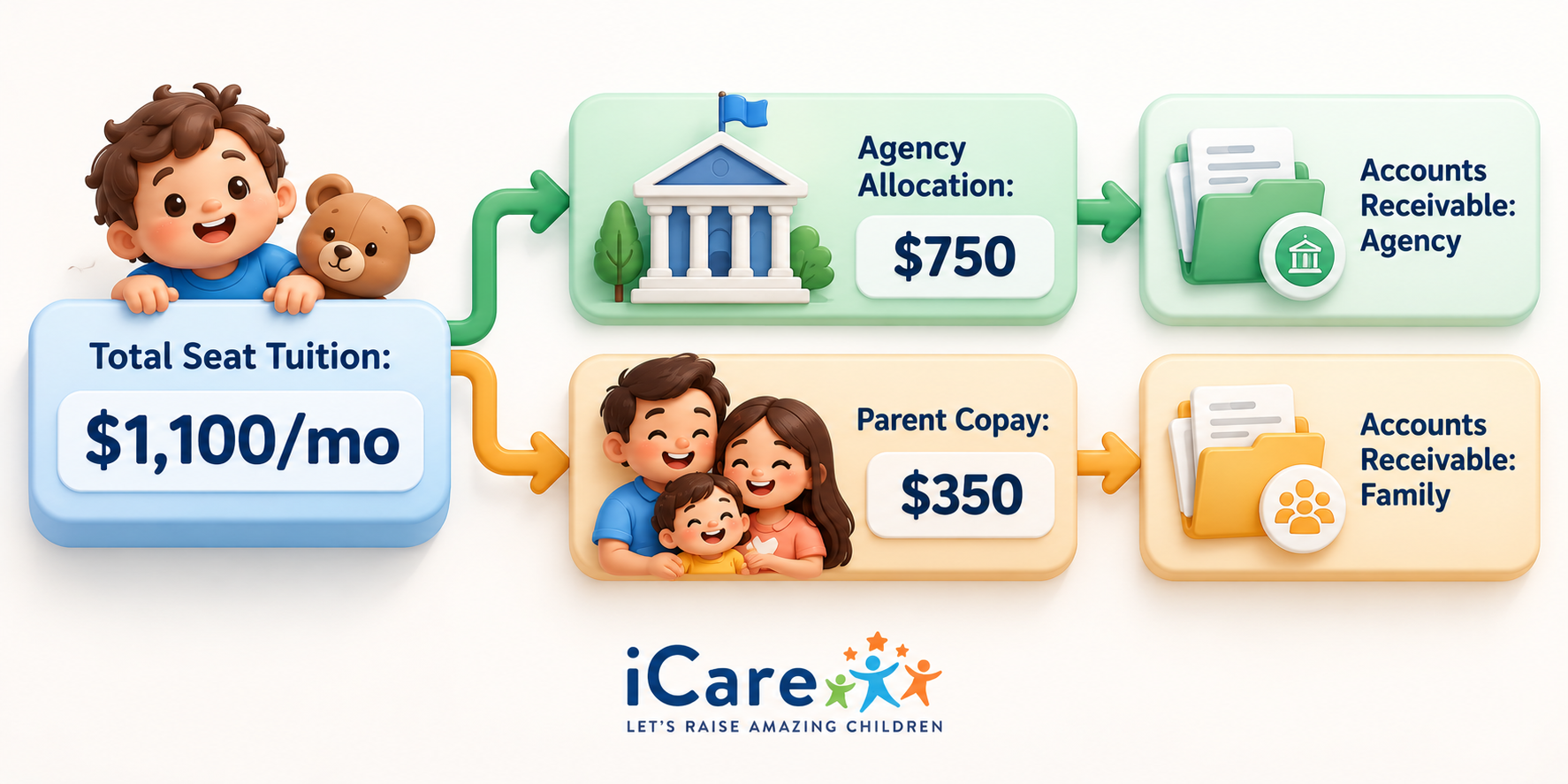
To run this layer cleanly, build an independent tracking ledger for every subsidized seat. Track authorized amounts, submitted claims, received payments, and pending balances separately from personal family accounts. Staying prepped for subsidy audits keeps your paperwork organized and protects your program from state repayment demands.
Layer 2: Parent Copays and Scheduled Childcare Payments
A copay is the remaining tuition balance an enrolled family pays out of pocket after public assistance is applied.
Problems start when administrative staff treat the copay as whatever amount remains on an invoice. If your state agency modifies its daily rate or trims authorized hours, center staff often forget to adjust the parent’s recurring charge. The family continues to pay their old rate, and the center absorbs the difference for months before anyone notices.
Try to avoid treating copays as loose change. Record every parent’s copay as a defined line item backed by an enrollment contract. When an agency updates its terms, change the parent’s billing record right away instead of making manual adjustments to individual receipts.
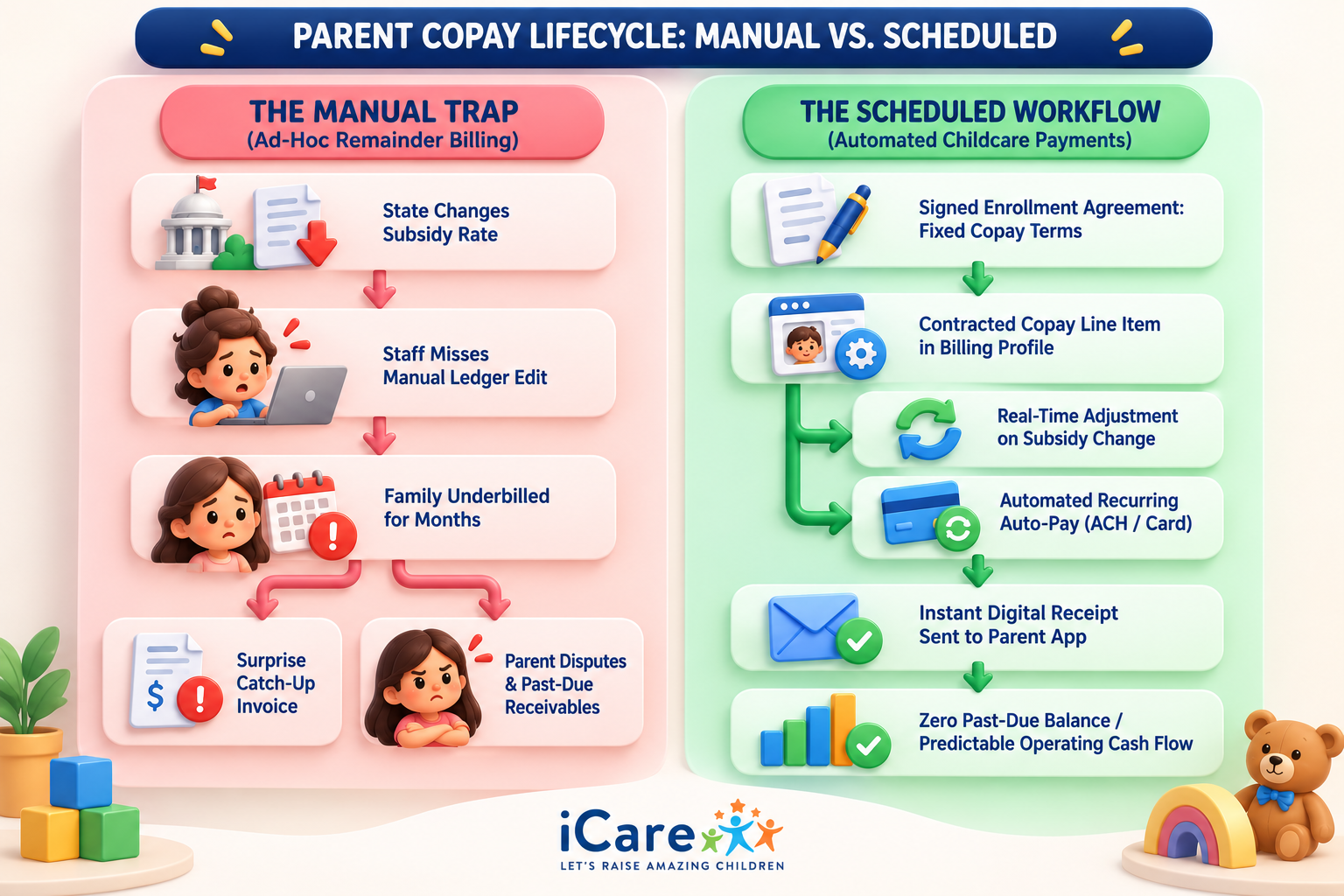
Establishing reliable childcare payments through automated ACH processing keeps account balances from drifting into past-due status.
Layer 3: Sibling, Staff, and Multi-Child Discounts
Tuition reductions help fill classrooms and retain loyal families, but they introduce chronic financial leakage when managed through manual invoice edits. Most early learning programs run several discount structures at once:
- Multi-child discounts for families with two or more enrolled siblings.
- Staff discounts for teachers whose children attend the center.
- Advance payment incentives for families paying by quarter or year.
- Corporate rates for hospital systems, first responders, or local partners.
So, when administrative staff manage these deductions through manual invoice overrides, deductions tend to become permanent by accident.
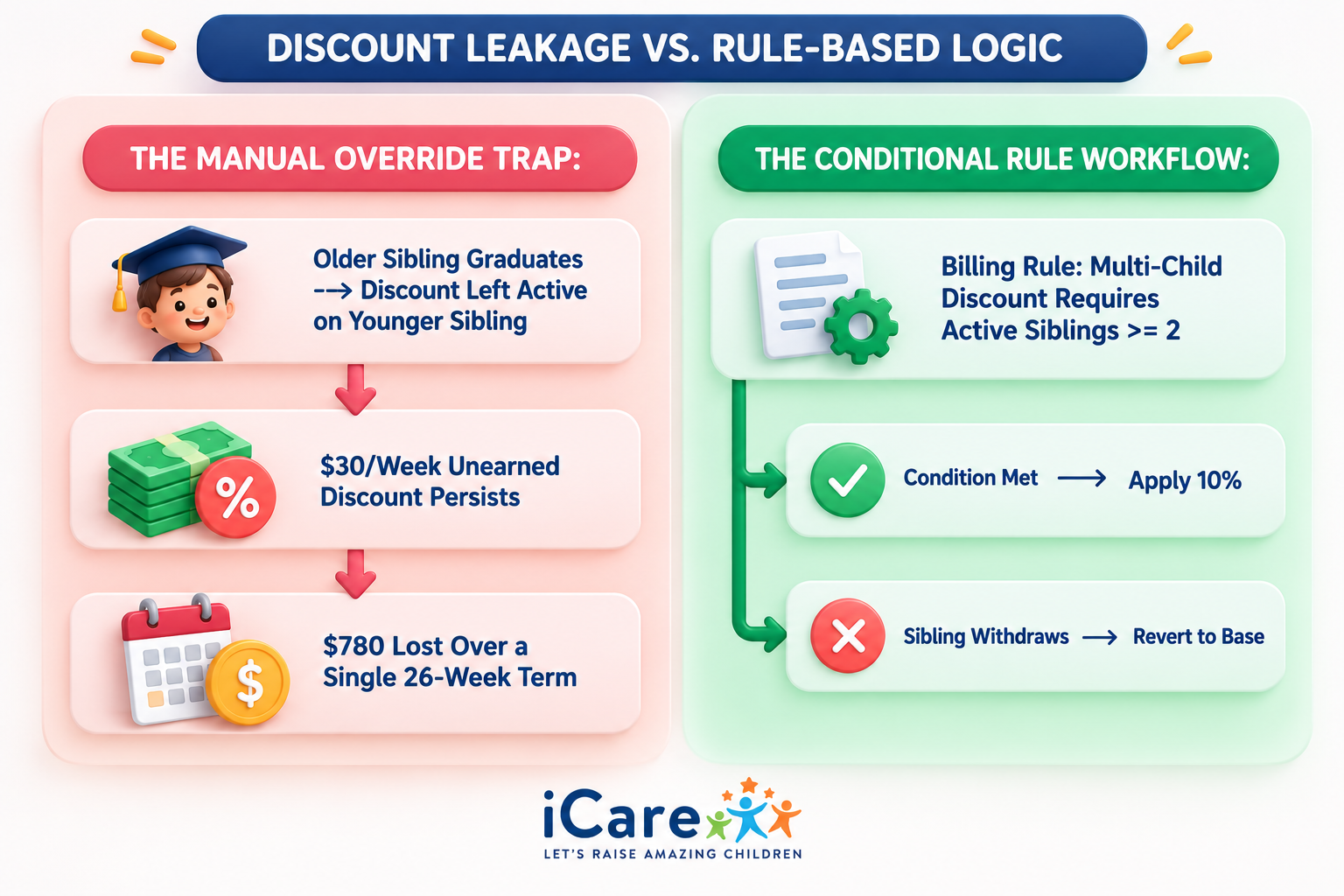
Let’s consider an everyday scenario. A family enrolls in both an infant and a preschooler, qualifying for a 10 percent discount on the young child’s tuition. When the preschooler heads to kindergarten in August, the front desk updates the classroom roster but forgets to edit the family’s billing template. The center quietly loses $30 every week for the fall semester.
Three routine discounted oversights cost school districts substantial revenue over the school year:
- Reducing tuition across all siblings instead of only the lowest-tuition child.
- When an employee leaves the program, their child discounts are active after an employee leaves the program.
- Stacked promotional registration offers on top of existing corporate partner agreements without director approval.
Stop treating discounts as open-ended invoice edits. Instead, tie every rate adjustment directly to active enrollment rules.
Modern daycare management software ensures that deductions are applied only when certain conditions are met. The moment an older sibling withdraws or graduates, the system recalculates the family ledger automatically, preserving your margins without awkward retroactive corrections.
Layer 4: Schedule Changes and Attendance Shifts
Children frequently change their attendance schedules throughout the year. A family might reduce attendance from five days to three days, an infant might begin care in the middle of a billing cycle, or an elementary student might require unexpected full-day care during school holidays.
Schedule adjustments present unique operational challenges because one change triggers updates across all three lower billing layers.
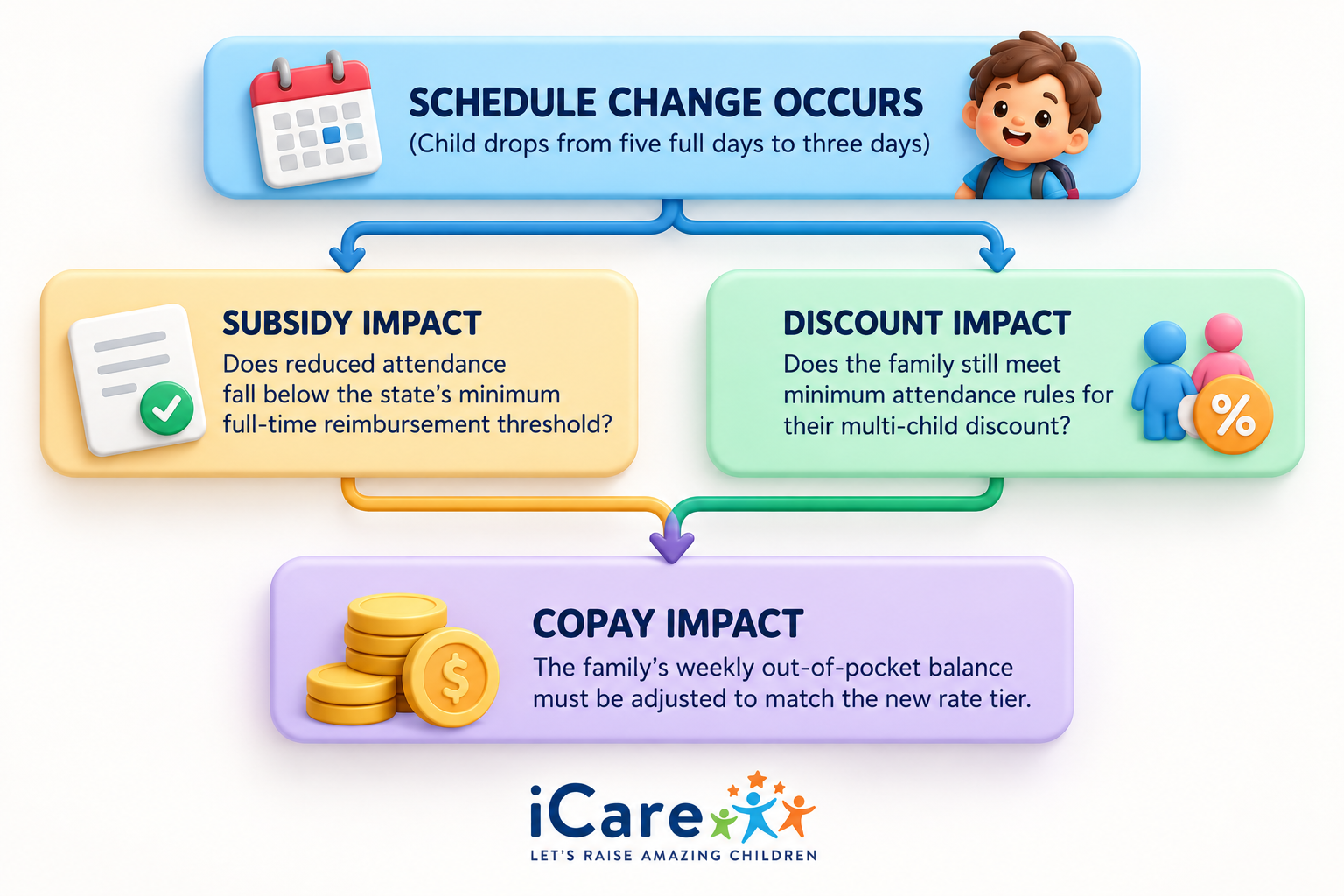
When an administrator updates a child’s classroom schedule on paper but fails to adjust the billing record, discrepancies multiply. The center ends up submitting inaccurate subsidy hours, underbilling the parent copay, or applying unearned discounts.
The Real Cost of Inaccurate Daycare Billing
When an early learning center manages variable billing using disconnected spreadsheets, administrative errors quietly multiply. These oversights lead to predictable operating challenges:
- Distorted Operating Projections: Uncollected agency balances recorded as cash inflate financial forecasts, making payroll and purchasing decisions risky.
- Staff Fatigue: Directors spend hours cross-referencing bank statements and paper sign-in sheets instead of supporting classroom curriculum.
- Damaged Family Relationships: Surprise billing adjustments and confusing invoices frustrate parents and damage center trust.
- Audit and Compliance Risk: State licensing agencies can reclaim disbursed subsidy funds if attendance timestamps and billing statements do not match approved authorizations.
Establishing structured billing rules removes guesswork, ensuring centers charge accurately for every hour of care provided.
A Weekly and Monthly Financial Audit Checklist for Childcare Payments
Maintaining accurate accounts does not require an outside accounting firm, just a consistent audit schedule. Your administrative team can easily catch balance errors before invoices go out once you separate quick weekly spot-checks from thorough monthly reconciliations.
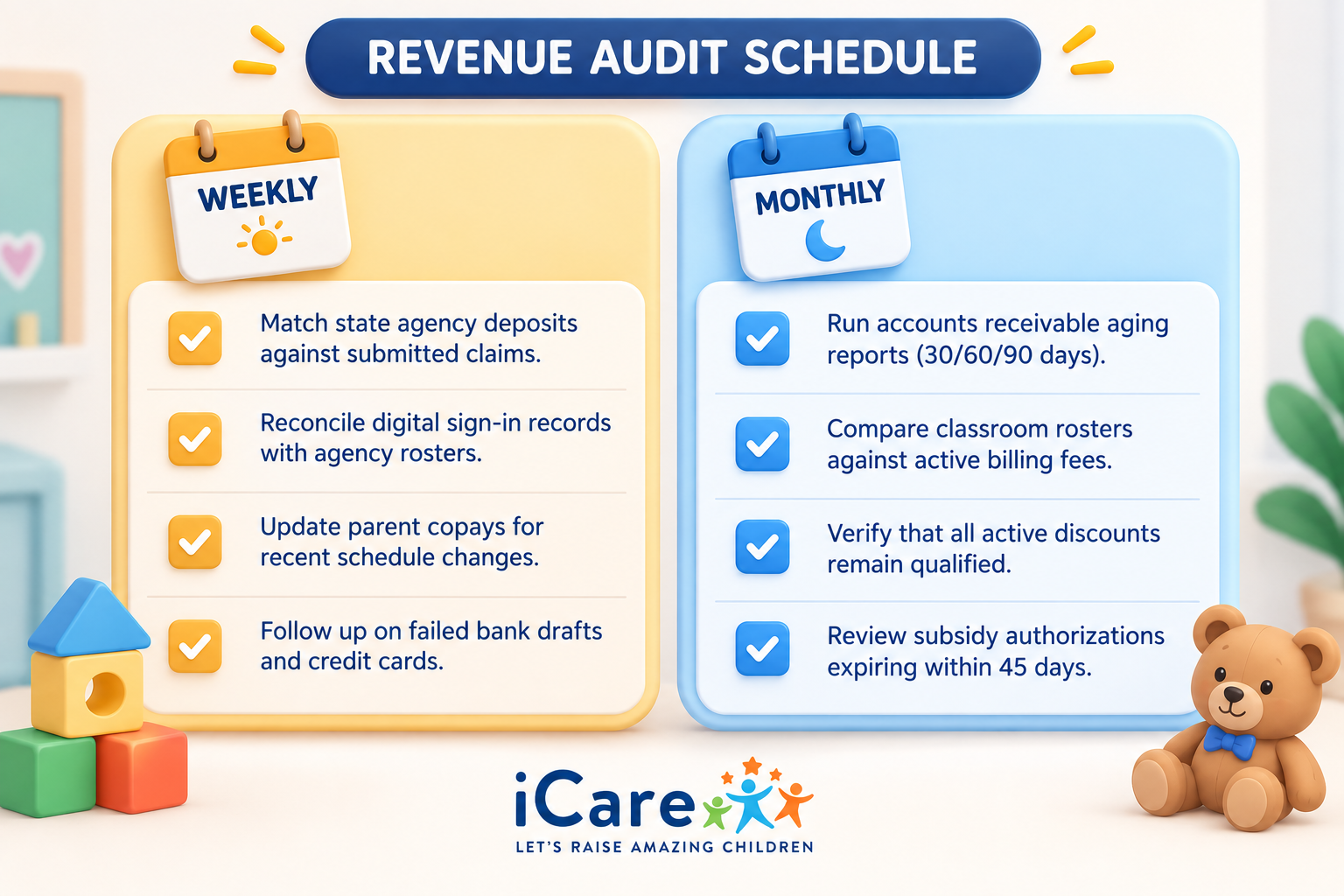
The 30-Minute Weekly Checklist
Set aside 30 minutes every Friday to review current accounts:
- Reconcile Agency Deposits: Compare state direct deposits against submitted attendance claims. Record any differences and file corrections within state deadlines.
- Review Attendance Logs: Confirm that digital sign-in timestamps meet minimum attendance thresholds for subsidized seats.
- Verify Schedule Changes: Check schedule adjustments submitted during the week. Ensure that tuition rates, copay amounts, and discounts were updated together.
- Address Failed Payments: Review your payment processor dashboard for returned checks or declined cards. Notify parents right away before balances roll over.
The Comprehensive Monthly Audit
At the end of each month, conduct an account-level review across your center:
- Review Aged Accounts Receivable: Divide overdue balances into 30, 60, and 90-day intervals. Keep agency balances separate from family balances so your staff follows up with the correct party.
- Cross-Check Rosters and Billing: Compare physical classroom rosters with your active billing ledger. Confirm that every child attending class has an active, billable account.
- Audit Active Center Discounts: Review all accounts receiving multi-child or staff discounts. Confirm that the qualifying sibling or employee is still active at the center.
- Track Expiring Subsidy Certificates: Check for state authorizations set to expire within the next 45 days. Remind parents to submit their renewal paperwork early to avoid coverage gaps.
Choosing Dedicated Childcare Billing Software
Technology cannot fix undefined center policies. If your family contract lacks clear rules regarding who covers agency shortfalls, software alone will not resolve billing arguments. Clear internal policies must always guide automated tools:
| Policy Area | What Centers Must Define | What Software Automates |
|---|---|---|
| Parent Balances | Terms for payment methods, schedules, and late fees | Recurring direct debits and digital receipts |
| Third-Party Deficits | Parent responsibility when an agency reduces funding | Splitting charges across multiple payers automatically |
| Family Discounts | Specific eligibility conditions and sunset rules | Removing credits when an older child un-enrolls |
| Program Schedules | Notice windows for withdrawal and schedule drops | Prorating fees and updating linked copay balances |
Programs that upgrade to purpose-built daycare billing software avoid errors common to generic invoicing platforms. Look for systems designed around early education realities:
- Dual-Payer Invoicing: The platform must split an enrolled seat between a family and a public agency without cross-contaminating records.
- Attendance-Linked Claims: Digital check-in timestamps should sync with subsidy attendance reports to support state audits.
- Automated Discount Conditions: Fee reductions must be governed by system rules that expire automatically when classroom enrollment changes.
- Integrated Parent Communication: A dedicated parent portal lets families review charges, settle balances, and access annual tax statements independently.
Your administrative team can focus on supporting your school community by using reliable daycare software and childcare billing software.
How iCare Software Simplifies Multi-Payer Childcare Billing
Standard small-business childcare apps assume one customer pays one invoice. Childcare centers deal with a messier reality. Here is how iCare handles multi-payer billing without manual headaches:
- Automatic split-payer ledgers: The system calculates your base tuition and divides it instantly. Agency voucher amounts route to an agency receivable ledger, while parents receive a clear, separate invoice for their copay. Nobody on your team has to calculate split balances on paper.
- Attendance-backed subsidy claims: Check-in and check-out timestamps sync straight into your subsidy reports. Directors see attendance deficits before submitting monthly claims, stopping voucher denials and audit clawbacks before they happen.
- Discounts that turn off on their own: You set discount rules once. When an older sibling moves on to kindergarten, iCare automatically bumps the younger child back to the standard rate. Staff tuition discounts link directly to employee profiles, adjusting the day employment status changes.
- Straightforward parent payments: Families review itemized charges, save payment details, and pay copays directly inside the childcare app. Automated reminders handle upcoming due dates, and scheduled autopay collects tuition before attendance begins.
- One connected center platform: Using dedicated childcare management software means your billing stays tied directly to classroom rosters, staff-to-child ratios, and state licensing logs. Nobody wastes time cross-referencing three different spreadsheets to see where center revenue stands.
Frequently Asked Questions
What is a childcare subsidy and how does it affect billing?
A childcare subsidy is government financial assistance that covers tuition costs for eligible families. Accepting subsidies creates a split-payer account where the seat is funded by an agency voucher and a family copay, each running on separate payment schedules.
What is the difference between a subsidy and a copay?
A subsidy represents public financial assistance distributed directly to the center by an agency. A copay is the remaining out-of-pocket tuition balance that the enrolled child’s parents agree to pay under their center contract.
How do I track subsidy payments separately from parent payments?
Maintain two separate accounts receivable ledgers for each subsidized enrollment. Track government vouchers as expected third-party receivables, and manage family copays as private customer accounts to prevent agency delays from distorting family balances.
Does copay size affect family stability?
Research analyzing state subsidy policies indicates that copay size does not show a direct link to child maltreatment rates. High minimum work-hour requirements to qualify for care were associated with increased child neglect rates, highlighting the need to eliminate administrative friction for working families.
What happens to a family’s copay if their subsidy amount changes?
Staff should update the family’s master billing schedule immediately whenever an agency changes its reimbursement rate. An integrated platform recalculates the parent’s ongoing share automatically without modifying past paid statements.
How should I handle a sibling discount when one child receives a subsidy?
Apply the discount percentage exclusively to the private out-of-pocket parent balance of the eligible sibling. Never deduct sibling discounts from the gross tuition total before calculating the state subsidy portion.
What should I check first if center revenue is lower than expected?
Review your aged accounts receivable ledger for unpaid agency reimbursements and uncollected parent copays. Next, check active classroom rosters against current billing profiles to ensure recent room transitions and schedule increases were billed correctly.
Final Thoughts: Closing Financial Gaps with Modern Childcare Billing Software
Tuition collection is only the visible surface of a financially stable early learning business. Real operational health requires balancing baseline tuition, government agency allocations, family copayments, conditional discounts, and mid-cycle schedule shifts inside a single connected record.
Managing these elements on separate spreadsheets or generic retail invoicing tools guarantees revenue loss through missed subsidy claims, lingering discounts, and inaccurate family statements.
iCare Software eliminates this administrative burden by handling the multi-payer relationships unique to early childhood centers. The platform links classroom sign-in records directly to state agency billing guidelines, manages family copays independently from public receivables, and updates rate changes automatically when children move between age groups.
Your front-desk team can finally stop recalculating split balances manually on Friday afternoons. Investing in a system built for multi-payer accounting gives you predictable cash flow, audit-ready records, and more time to focus on supporting teachers and children.
Ready to eliminate billing exceptions and stabilize your cash flow?