
Running a strong childcare program has never depended on one single task. It depends on hundreds of operational decisions happening every day.
A child changes schedules. Attendance differs from what was originally booked. A teacher calls out unexpectedly. A family needs a billing adjustment. A subsidy payment does not match the parent balance. A licensing report is suddenly required. A parent needs an immediate update.
Individually, these situations are manageable.
The challenge begins when every change has to be updated across several disconnected systems.
A schedule change may need to be reflected in enrollment records, attendance, classroom staffing, billing, parent communication, and reporting. When these functions are managed separately, administrators become the connection between the systems. That is where time disappears.
In 2026, forward-thinking childcare leaders are not simply looking for more software. They are looking for better operational resources that reduce the administrative work created by the complexity of childcare itself.
The objective is not to replace experienced leadership with technology.
It is to give leaders a stronger operational foundation so they can focus their time on children, families, staff, program quality, and growth.
Key Takeaways
- The biggest administrative burden in childcare often comes from exceptions, not routine tasks.
- Attendance, staffing, billing, enrollment, communication, and reporting are operationally connected, even when the software managing them is not.
- Disconnected systems force administrators to manually reconcile information between departments and workflows.
- Standard software features are no longer enough; childcare organizations need systems capable of supporting the way their individual programs actually operate.
- iCare is designed around connected childcare workflows and real operational scenarios rather than treating attendance, billing, staffing, and communication as isolated functions.
- Better operational visibility can help directors grow their programs without increasing administrative complexity at the same rate.
What Are Operational Resources in Childcare?
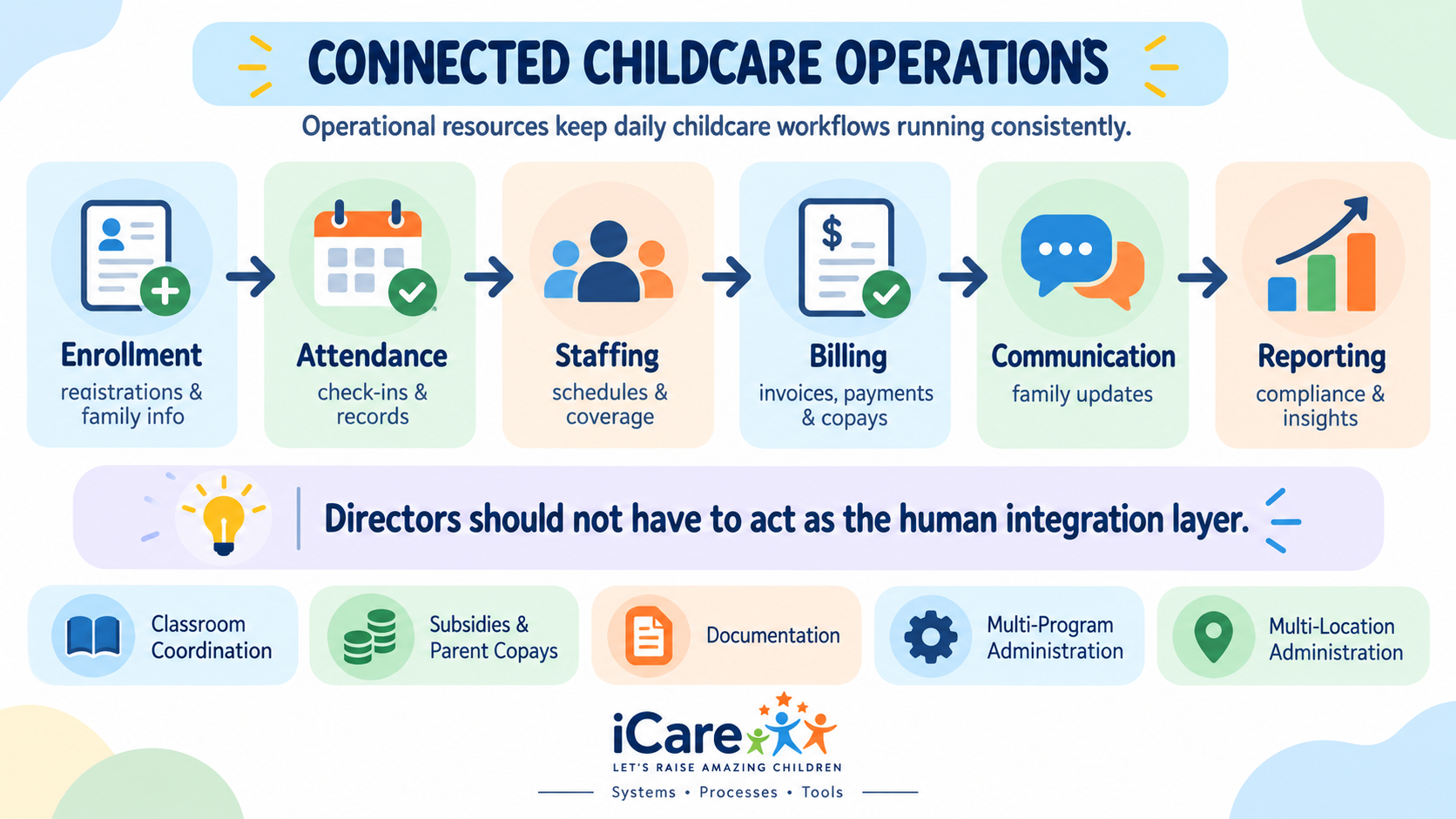
Operational resources are the systems, processes, and tools a childcare organization relies on to keep daily operations running consistently.
They typically support areas such as:
- Enrollment and registration
- Attendance
- Staff scheduling
- Classroom coordination
- Billing and payments
- Subsidies and parent copays
- Family communication
- Documentation
- Reporting
- Multi-program or multi-location administration
But the real value of operational resources is not the number of features available.
It is how effectively those resources support the relationships between different parts of the childcare operation.
A director should not have to become the human integration layer between enrollment, attendance, staffing, billing, communication, and reporting systems.
Strong operational resources reduce that dependency.
Why Childcare Operations Become Difficult Even When the Program Is Running Well
Many operational problems do not appear because a childcare center is poorly managed.
They appear because childcare is inherently complex.
This operational pressure exists within a childcare market already facing significant capacity and affordability challenges. Child Care Aware of America’s Child Care in America: 2025 Price & Supply report found that the number of licensed childcare centers declined slightly in 2025, while the national average annual price of care reached $13,184. These pressures make efficient use of staffing, capacity, billing, and administrative resources increasingly important for childcare leaders.
A program might have clearly documented processes and experienced administrators, yet still lose significant time when the systems behind those processes are disconnected.
Consider one simple example.
A child normally attends three days each week but temporarily moves to five days. That change may affect:
- Enrollment and Scheduling: The child’s expected schedule needs to be updated.
- Classroom Capacity: The center may need to confirm whether the classroom can accommodate the additional attendance.
- Staffing: The change may affect staffing requirements or classroom ratios.
- Billing: The family’s tuition may need to be recalculated.
- Parent Communication: The family and relevant educators need consistent information.
- Reporting: Enrollment, attendance, billing, and operational reports need to reflect the change accurately.
The problem is not the schedule change itself.
The problem is having to process the same operational change repeatedly across different systems.
This is one of the most important differences between having childcare software and having connected childcare operations.
Where Directors Actually Lose Administrative Time
Routine transactions are rarely the most difficult part of childcare management. Exceptions are.
Attendance Does Not Always Follow the Planned Schedule
A classroom may begin the week with one expected roster and finish the week with something completely different.
Children may:
- Be absent unexpectedly
- Attend additional days
- Arrive late
- Leave early
- Change schedules
- Move between care arrangements
If staffing is planned using static schedules while attendance is tracked somewhere else, directors have to manually connect those two realities.
Better operational systems give leaders visibility into both planned and actual participation so staffing decisions can be made using more current information.
Billing Becomes Complicated When Real Life Does Not Follow the Standard Rate
Recurring tuition is relatively simple. Real childcare billing often is not.
Consider situations such as:
- A child changes from half-day to full-day care
- A family adds an extra day
- A child stays beyond the scheduled pickup time
- A sibling discount needs to be applied
- A family’s rate changes
- A subsidy covers part of the cost
- The parent remains responsible for a copay
- Subsidy reimbursement differs from the expected amount
- Attendance affects what needs to be charged
- A schedule changes in the middle of a billing period
The administrative burden appears when these scenarios have to be calculated outside the system, checked manually, and then reconciled later.
This is why effective childcare billing cannot be treated as nothing more than recurring invoicing.
It needs to reflect the way childcare programs actually operate.
iCare is designed to support childcare workflows where billing can be connected with enrollment, schedules, attendance, family accounts, and other operational information rather than functioning as a completely separate administrative process.
Staffing Decisions Need More Than a Static Schedule
Staffing pressure also extends beyond individual centers. According to the U.S. Bureau of Labor Statistics, approximately 150,300 childcare worker openings are projected each year from 2025 to 2035, largely because workers leave the occupation or the labor force. For directors, that makes effective scheduling and better visibility into actual attendance even more important.
Staffing is the area where apparently simple processes become operationally complex. A schedule may tell a director who is expected to work.
But staffing decisions can also depend on:
- Actual child attendance
- Classroom capacity
- Program schedules
- Staff availability
- Changes during the day
- Different program types
When this information lives in separate systems, directors may have to compare spreadsheets, attendance records, schedules, and classroom information before making a decision.
The issue is not whether a system offers a “staff scheduling feature.”
The more important question is: Can staffing decisions be made with visibility into what is actually happening in the program? That distinction matters.
Documentation Should Not Become a Project Every Time Someone Needs a Report
Childcare organizations maintain significant operational records.
The documentation burden is also influenced by regulatory requirements. Childcare.gov explains that licensed childcare programs must meet state and territory requirements related to areas such as staff qualifications and training, health and safety, supervision, emergency preparedness, and ongoing monitoring. Maintaining accessible and consistent operational records can therefore support both everyday management and compliance preparation.
Licensing reviews, funding requirements, internal reporting, financial questions, attendance history, and family-account issues may all require historical information.
When those records are scattered across paper files, spreadsheets, emails, and separate applications, producing a report often means reconstructing what happened.
A connected operational system creates a more reliable history of the program. That can make documentation easier to access when leadership, licensing teams, finance teams, or other stakeholders need it.
Parent Communication Becomes Harder When Everyone Has Different Information
Families expect clear and timely communication. Teachers need information relevant to the classroom. Administrators need visibility across the entire program.
Problems arise when these groups are working from different systems or different versions of the same information.
A schedule might change in one system but not another. A billing adjustment may be visible to administration but unclear to the family. A classroom update may be communicated through one channel while operational information appears somewhere else. Better communication is therefore not only about sending messages faster. It is about making sure those messages are supported by consistent operational information.
Why Adding More Software Does Not Always Solve the Problem
When childcare organizations experience operational friction, the natural reaction is often to add another tool.
- One application manages attendance.
- Another manages communication.
- Another manages billing.
- Another handles scheduling.
- Another produces reports.
Each tool may perform its individual function well.
But every additional system creates another place where information may need to be entered, updated, checked, exported, or reconciled.
The result can be a technology stack with many useful features but significant administrative friction between them.
That is why directors should evaluate childcare management software based on more than a feature checklist. The better question is: How much work remains between the features?
Connected Childcare Operations vs. Disconnected Tools
| Disconnected Operations | Connected Operations |
|---|---|
| Enrollment updated separately | Enrollment information supports related workflows |
| Attendance tracked independently | Attendance can inform operational decisions |
| Staffing based primarily on static schedules | Staffing decisions have greater visibility into participation |
| Billing exceptions calculated manually | Billing workflows can reflect childcare-specific changes |
| Parent communication exists in another system | Communication is connected to broader program information |
| Reports require data from several sources | Operational information remains more centralized |
| Each location develops separate processes | Leadership can maintain broader organizational visibility |
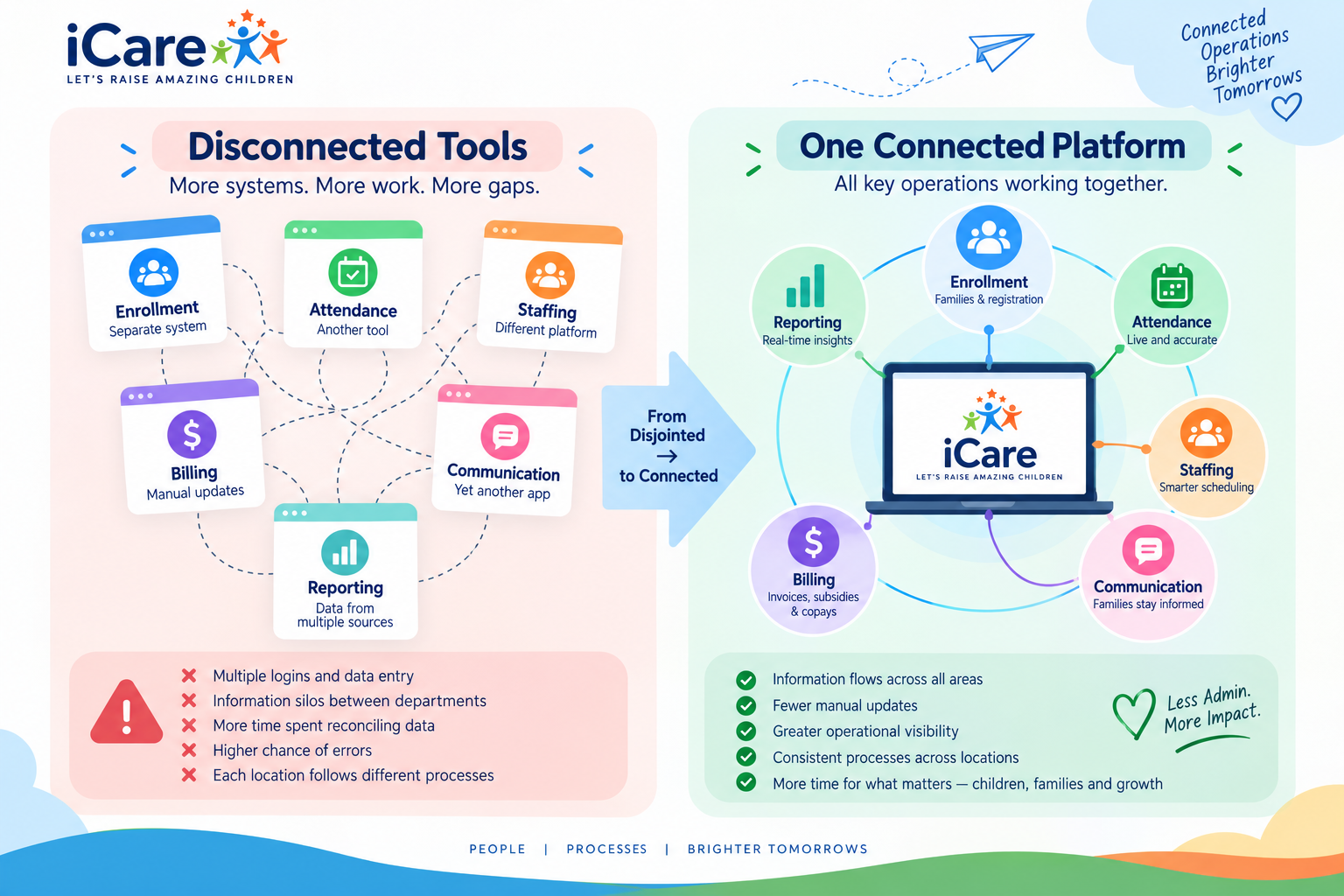
The goal is not simply having everything “in one place.” The real value is reducing the number of times administrators have to move information manually between operational processes.
What Should Directors Look for in Childcare Management Software?
Basic features are no longer enough to differentiate one childcare platform from another. Most serious systems can claim some combination of attendance, billing, communication, enrollment, and reporting.
Directors should look deeper.
Can the System Handle Exceptions?
Ask vendors how their systems handle situations outside the standard workflow. For example:
- What happens when a child’s schedule changes mid-month?
- How are additional days handled?
- Can different billing rules be accommodated?
- How are subsidies and parent copays managed?
- What happens when attendance affects billing?
- Can different programs operate differently within the same organization?
The answers to these questions often reveal more than the feature list.
Can Different Workflows Stay Connected?
A childcare system should not simply contain multiple modules. Those modules should support the same operational reality. Enrollment should not tell one story while billing tells another. Attendance should not exist separately from the information directors need for staffing and reporting. The strength of a childcare management platform comes from how these workflows interact.
Can the Platform Adapt to the Program?
A preschool does not operate exactly like a before- and after-school program. A drop-in care organization operates differently again. A multi-location organization has another level of complexity.
Even two childcare centers serving similar families may structure schedules, billing, staffing, programs, and administrative workflows differently.
That means software should support the program’s operating model rather than requiring every organization to redesign its processes around a rigid template.
iCare supports organizations including centers and preschools, before- and after-school programs, and drop-in care programs.
The objective is not to assume every childcare organization works the same way. It is to support the operational differences that make each program unique.
How iCare Approaches Childcare Operations Differently
iCare brings together many of the functions directors expect from childcare management software:
- Enrollment
- Attendance
- Staff scheduling
- Billing and payments
- Parent communication
- Documentation
- Reporting
But the differentiation is not simply the presence of those features. It is the operational relationship between them.
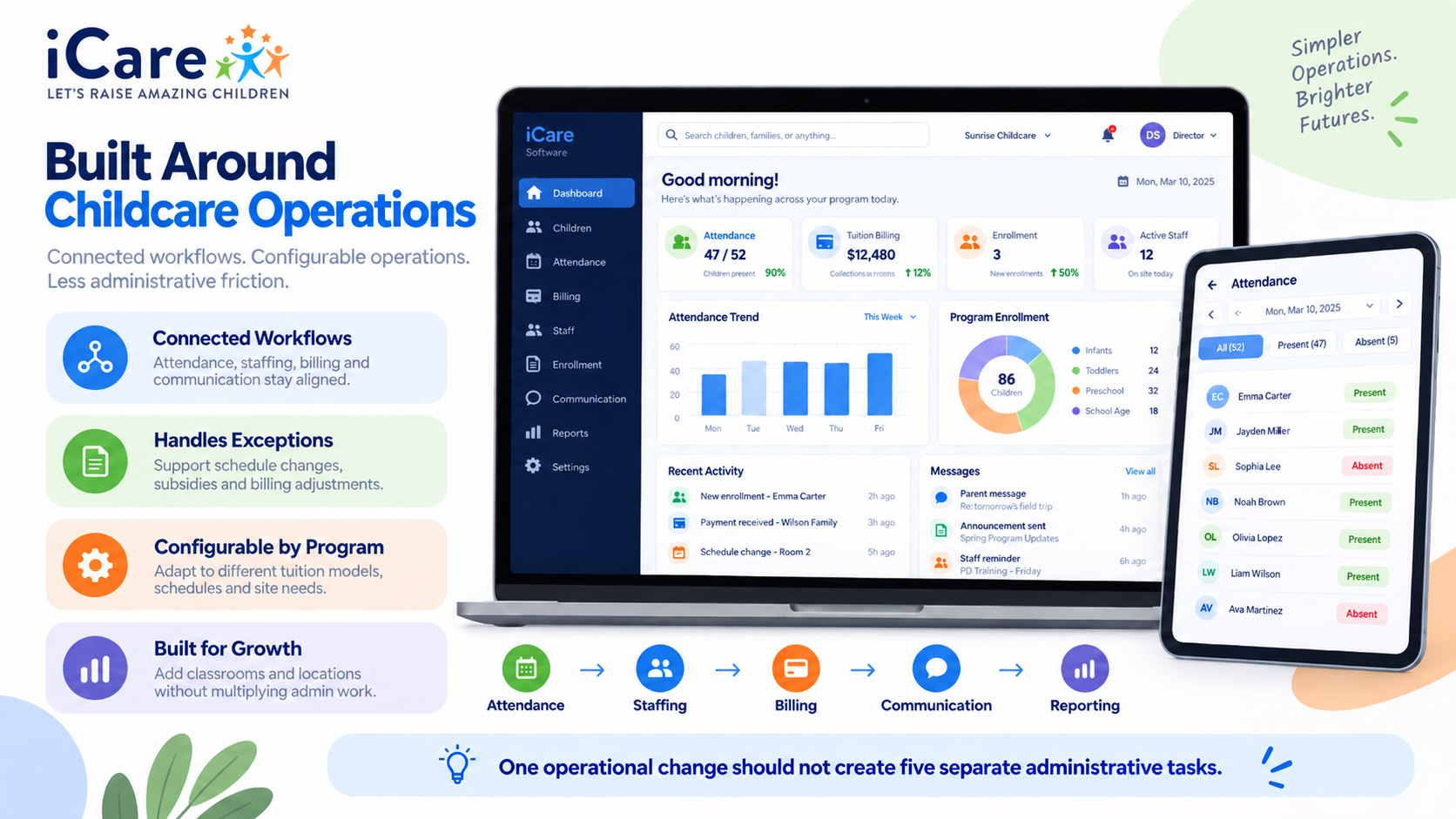
A change in a childcare program rarely affects just one administrative function. A schedule change can affect attendance. Attendance can affect staffing. Schedule or attendance changes may affect billing. Billing changes may require family communication. All of those activities eventually influence reporting.
iCare is designed around these connected childcare workflows so administrators do not have to recreate the relationship between them manually.
The objective is simple: One operational change should not unnecessarily create five separate administrative tasks.
Childcare Operations Are Defined by Exceptions
Many software platforms work well when everything follows the standard process. Childcare rarely does. The real test of a childcare management system is what happens when reality deviates from the template.
For example:
- A child attends longer than expected: Does the administrator have to manually determine the impact on billing?
- A subsidized family’s responsibility changes: Can the workflow account for both subsidy and parent responsibility?
- A schedule changes halfway through the billing period: Can the system reflect that operational change without administrators rebuilding the account manually?
- A growing organization introduces a new program model: Can the system support different rules without forcing every site into exactly the same workflow?
These are not edge cases. They are part of normal childcare operations. Technology that understands this complexity can remove substantially more administrative friction than technology designed primarily around standard transactions.
Better Software Should Fit the Program, Not Force the Program to Fit the Software
One of the biggest strategic decisions directors make when selecting childcare technology is how much operational flexibility they are willing to give up. Rigid systems may be easier to standardize, but childcare organizations often have legitimate reasons for operating differently.
They may have different:
- Scheduling models
- Tuition structures
- Subsidy arrangements
- Classroom configurations
- Attendance patterns
- Family requirements
- Program types
- Location-specific processes
This is where configurability becomes more important than another feature on a checklist. The system should create enough consistency for leadership to maintain control while allowing enough flexibility for programs to operate effectively. That balance becomes increasingly important as organizations grow.
Preparing for Growth Without Multiplying Administrative Complexity
Growth introduces opportunity. It also introduces coordination. Adding another classroom may mean more children, educators, schedules, billing relationships, communication, and reporting. Adding another location introduces another layer.
Without connected systems, growth can create:
- More spreadsheets
- More duplicate processes
- More manual reconciliation
- More communication channels
- More reporting work
- Less visibility for leadership
This creates an important operational question: Does administrative complexity increase every time the organization grows?
The right childcare management platform should help prevent that. Leaders should be able to expand programs while maintaining visibility into the operational information that matters across classrooms, services, and locations.
Supporting Teachers and Families Without Creating More Systems
Administrators are not the only people affected by childcare operations. Teachers need classroom information. Families need reliable access to communication and account information.
iCare’s Teacher App helps educators stay connected to relevant classroom and attendance workflows. The Parent App gives families a connected channel for information and communication with the program.
The value is not simply offering two additional applications. Their value increases because they are part of the same broader operational environment. When administrators, educators, and families work from connected information, fewer gaps have to be resolved manually.
Better Operational Resources Create Business Impact, Not Just Administrative Convenience
Reducing administrative work is useful. But directors and owners should also consider the broader business impact.
Operational friction can influence:
- Staff productivity
- Billing accuracy
- Parent experience
- Leadership visibility
- Capacity utilization
- Program scalability
- Administrative staffing requirements
- Decision-making speed
For example, if leadership cannot easily understand attendance patterns, it becomes harder to evaluate staffing or capacity. If billing exceptions require significant manual intervention, finance administration becomes harder to scale. If different locations operate through disconnected processes, leadership may struggle to maintain consistent oversight.
Operational resources therefore affect more than convenience. They influence how efficiently the organization can operate and grow.
Frequently Asked Questions About Childcare Management Software
What is childcare management software?
Childcare management software is a digital platform used to manage the administrative and operational activities of childcare organizations. Depending on the platform, this may include enrollment, attendance, staff scheduling, billing, payments, family communication, documentation, and reporting.
What are operational resources in childcare?
Operational resources are the systems, processes, and tools childcare organizations use to manage daily operations. These may include enrollment systems, attendance tracking, staff scheduling, billing tools, communication systems, reporting platforms, and documentation processes.
How does childcare management software help directors?
Childcare management software can reduce repetitive administrative work by centralizing operational information. When enrollment, attendance, staffing, billing, communication, and reporting are connected, directors spend less time reconciling separate systems and gain clearer visibility into program operations.
What should childcare directors look for when choosing software?
Directors should look beyond standard feature lists. Important questions include whether the system can handle childcare-specific billing and scheduling exceptions, connect operational workflows, support different program models, provide useful reporting, and scale as the organization grows.
Why are billing exceptions important when evaluating childcare software?
Routine recurring tuition is usually straightforward. Administrative complexity appears when families have schedule changes, additional attendance, discounts, late charges, subsidies, copays, or other exceptions. Software that cannot handle these situations effectively may still leave administrators performing significant manual work.
What is the difference between connected childcare software and separate apps?
Separate apps may manage individual functions effectively, but administrators often need to move or reconcile information between them. Connected childcare software allows related operational workflows to share information, reducing duplication and making it easier to maintain consistency across the program.
Can childcare management software support different program models?
Some platforms can support multiple childcare models, but directors should evaluate how configurable the system is. Preschools, childcare centers, after-school programs, drop-in care, and multi-location organizations can have very different schedules, billing structures, staffing needs, and operational workflows.
How can childcare management software support multi-location growth?
A connected platform can help leadership maintain organization-wide visibility while individual locations continue managing their day-to-day operations. This can reduce the need to create separate administrative systems and reporting processes every time the organization adds another location.
Stronger Childcare Programs Need More Than More Features
The future of childcare management is not about giving directors another dashboard. It is not about adding another application. And it is not about creating longer feature lists. The real opportunity is removing the operational friction that sits between enrollment, attendance, staffing, billing, communication, and reporting.
Experienced childcare leaders already know how to run their programs. Technology should make that expertise easier to apply. It should help directors see what is happening. It should reduce repetitive reconciliation. It should accommodate the exceptions that make childcare complex. And it should support growth without forcing administrative complexity to grow at the same rate. That is the role iCare is designed to play.
Built around the program. Built around the operational realities behind it. Built to support the people responsible for making childcare work every day.
Transform your childcare operations and eliminate administrative friction today.